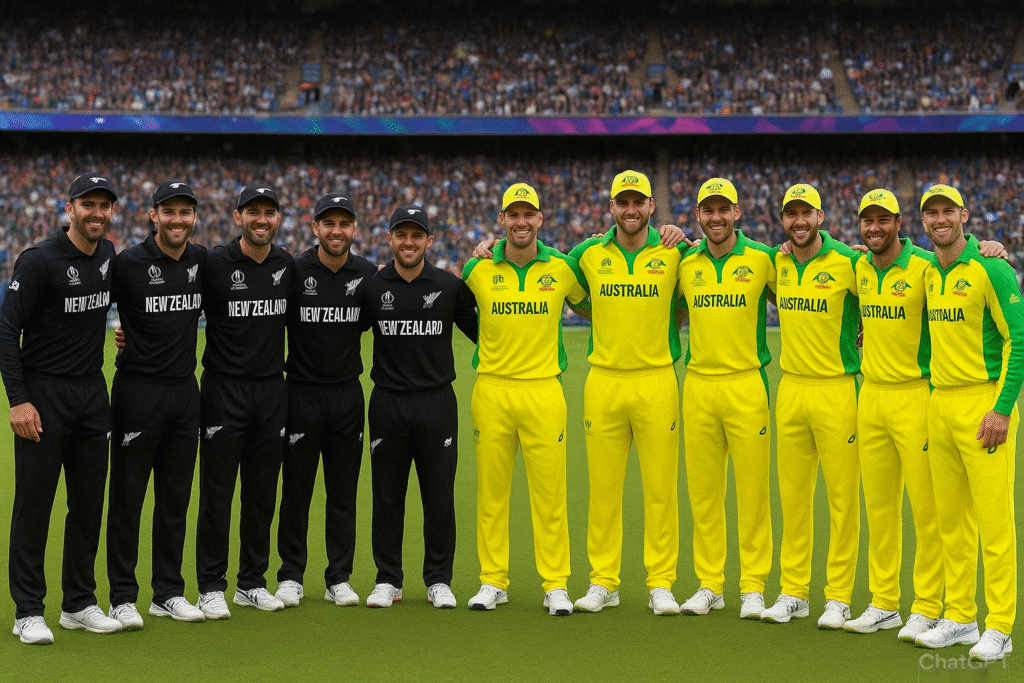
On October 1, 2025, New Zealand and Australia played the first T20I of a three-match series at the Bay Oval in Mount Maunganui. The cricket rivalry between the two countries was once again on display. Both teams had high hopes for the game: New Zealand wanted to take advantage of playing at home, and Australia wanted to show off their world-class firepower. The match was exciting, with a heroic century, explosive hitting, and a strong finish. In the end, Australia won by six wickets.
This article gives a full report on the match, including the toss result, the playing XIs, the most important players, the turning points, the final score, and a detailed look at what this match means for the rest of the series.
Toss and Playing XIs
Result of the Toss
Michael Bracewell, the captain of New Zealand, won the toss and chose to bat first. He wanted to put pressure on the Australians by getting a big score.
The New Zealand team is playing.
Tim Seifert (wk)
Devon Conway
Tim Robinson
Mark Chapman
Daryl Mitchell
Bevon Jacobs
Micael Bracewell (c)
Kyle Jamieson
Ish Sodhi
Matt Henry
Jacob Duffy
Australia’s Starting XI
Head of Travis
Mitchell Marsh (c)
Matt Short
Tim David
Alex Carey (wk)
Mitch Owen
Marcus Stoinis
Ben Dwarshuis
Sean Abbott
Adam Zampa
Josh Hazlewood
Both teams had well-balanced lineups, but Australia had a little more depth in batting and all-around options.
Robinson’s Only Fight in New Zealand’s Innings
New Zealand had a terrible start, losing three wickets for only six runs during the powerplay. Josh Hazlewood and Ben Dwarshuis, the Australian new-ball bowlers, were unrelenting. They used swing and early movement to break up New Zealand’s top order.
The Kiwis were in trouble at 6/3, but young star Tim Robinson stepped up and scored a great first T20I century. He scored 106 runs off 66 balls (11 fours and 5 sixes), which will go down as one of the best individual performances against a world-class Australian bowling attack.
Robinson found a partner in Daryl Mitchell (42 off 32 balls), and together they put together a crucial partnership of 92 runs that steadied the innings and made sure New Zealand got a good score.
After a terrible start, New Zealand ended up with a score of 181/6 in 20 overs, which is pretty good.
Best Players (NZ Batting):
Tim Robinson: 106* (66)
Daryl Mitchell—42 (32)
Best Bowlers (Australia):
Ben Dwarshuis: 2/33
1/24 for Josh Hazlewood
Australia’s Chase: Marsh is the best when things get tough
Australia needed a steady start to chase 182, and Travis Head gave them one with a quick 31 off 18 balls. But the real difference was made by captain Mitchell Marsh, who had one of the most destructive T20 innings of his career.
Marsh hit 85 runs off of only 43 balls, hitting 9 fours and 5 sixes. He broke down New Zealand’s bowling attack. Because of his timing, power, and ability to hit the short boundaries, the chase was one-sided.
Matt Short (29 off 18 balls) and Tim David (21 off 11 balls) both helped out, and Australia finished the chase in just 16.3 overs, with 21 balls to spare.
Best Batters (Australia):
Mitchell Marsh: 85 (43)
Travis Head—31 (18)
Matt Short: 29 (18)
Best Bowlers in New Zealand:
Matt Henry – 2/43
1/24 for Michael Bracewell
Important Turning Points
NZ’s early collapse (6/3): Australia’s new-ball bowlers set the tone early, putting New Zealand on the defensive.
Robinson’s rescue: His 106 not out not only saved NZ from embarrassment, but it also gave them a chance to win.
Marsh’s power hitting: The Aussie captain’s fearless style broke the chase open, leaving the NZ bowlers with no idea what to do.
Australia’s middle-order depth: Marsh’s strong play made sure that the chase never looked like it would fail, thanks to David and Short.
Last Result
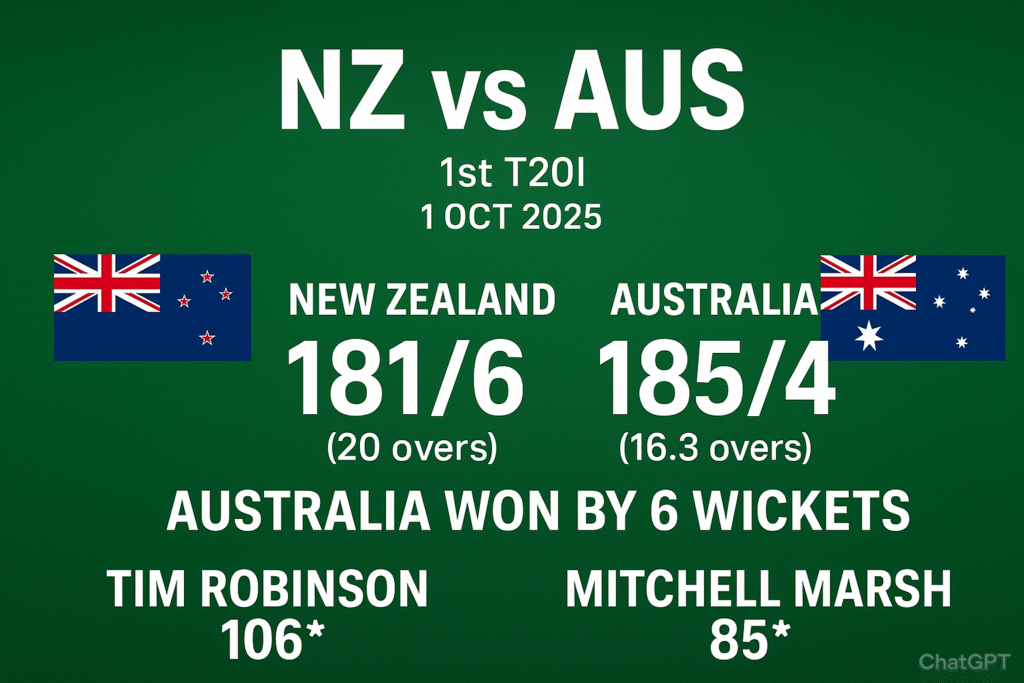
New Zealand: 181/6 (20 overs)
Australia: 185 for 4 (16.3 overs)
👉 Australia won by six wickets and is now ahead in the three-match series by one game.
What This Means for the Series After the Game for New Zealand
Tim Robinson’s century was a big plus because it showed that the team has young players who can compete with the best.
Concerns: The top order’s weakness and the bowling’s lack of consistency are still big problems. New Zealand might have a hard time in the rest of the matches if their bowlers don’t get Marsh out early and keep him from getting too many runs in the middle overs.
For Australia
Pros: Mitchell Marsh’s knock as captain showed that he is a good leader. The fact that the chase was so easy showed how deep and adaptable Australia’s batting was.
Concerns: Australia gave up more than 180 runs, which shows that their death bowling could use some work, even though they won.
This performance gives Australia a mental edge overall, and they will be big favorites going into the second T20I. To tie the series, New Zealand needs to get early wickets and make better plans for their bowling.
Questions and Answers
Q1: Who won the first T20I between New Zealand and Australia today (October 1, 2025)?
👉 Australia won by 6 wickets, chasing down 182 runs in 16.3 overs.
Q2: Who won the match?
👉 Mitchell Marsh hit 85 runs off 43 balls to win the match.
Q3: Who got the hundred in today’s game?
👉 Tim Robinson from New Zealand scored a great 106* off 66 balls.
Q4: How many games have been played in the series?
👉 Australia is ahead in the three-match T20I series by one game.
Q5: Where will the next game take place?
👉 The second T20I will take place in Wellington later this week.
Final Thoughts
The first T20I between New Zealand and Australia had it all: an inspiring century, fast bowling, and a strong finish. But the difference was that Australia could chase with authority, thanks to Mitchell Marsh’s innings as captain.
Australia is now in charge of the series (1–0) after this win. New Zealand needs to win the second game to stay in the series. If the Black Caps don’t fix their problems with bowling and early batting collapses, the Aussies could win the series before the last game.
As the Trans-Tasman rivalry continues to excite cricket fans all over the world, fans can look forward to more fireworks in the future.

1 thought on “New Zealand vs Australia 1st T20I 2025”